Tomsk scientists develop new concept of analytical realism in philosophy
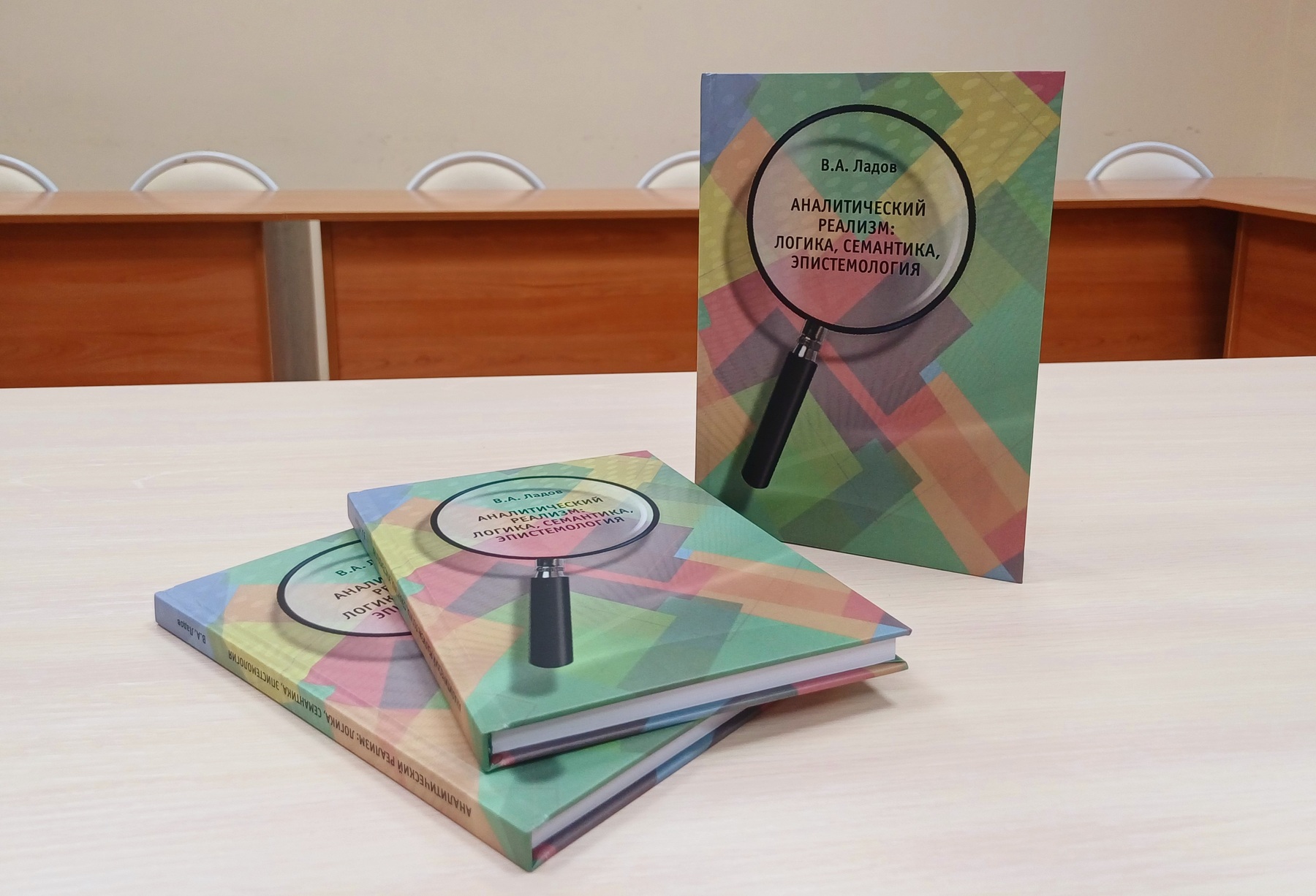
Researchers at Tomsk Scientific Center of the Siberian Branch of the Russian Academy of Sciences have announced the publication of a monograph on a new approach to analytical realism. The book, authored by Vsevolod Ladov, DSc in Philosophy and head of the Laboratory for logic and philosophy analysis, introduces a fresh epistemological framework that aims to align philosophy with other scientific disciplines. The monograph titled “Analytical Realism: Logic, Semantics, Epistemology” is the implementation of the Russian Science Foundation grant project 23-18-00019.

– For years, Russian philosophy has lacked original concepts focusing largely on reinterpretations of Western thought instead. It’s time we crafted our own ideas and concepts that, on the one hand, would fit into the global philosophical tradition, and on the other, contribute an original insight, – noted the author of the monograph and research project leader.
The proposed concept relies on the traditions of analytical philosophy – a rationalist and science-oriented approach that employs methods of logical and linguistic analysis to solve philosophical problems of knowledge. It originates in the early 20th century in the leading universities of Britain – Cambridge and Oxford, where Vsevolod Ladov interned, gathering materials for his doctoral dissertation.
Vsevolod Ladov highlights ongoing debates within epistemology between realism and anti-realism. Realists maintain that objective reality exists independently of human perception and language, shaping the ways we understand and describe it. Prominent thinkers like Nobel laureate Bertrand Russell and early Ludwig Wittgenstein were among the main proponents of this theory.
Conversely, anti-realists argue that reality as understood through cognition is merely a construct of the human mind, and the way we perceive it is dominated by linguistic structures we use to describe it.
– In his later work on language games, Ludwig Wittgenstein suggested the subjective nature of our representations of reality. He argued that when studying language, what we are dealing with is subjective notions of reality rather than reality itself. This largely determined the dominance of anti-realism in social philosophy, including analytical philosophy, – explains Vsevolod.
According to the researcher, subjective, relativistic, and anti-realism-oriented philosophy has no place in the world of rigorous laws of science and the processes of understanding and expressing objective reality through scientific theories should be central to modern philosophical inquiry. This perspective aligns philosophy more closely with scientific methods, emphasizing rational comprehension of the world as a unified pursuit.
Reinterpreting the relationship between a sense of a word and its referent – an entity it refers to – is expected to add to the framework’s flexibility. Since, in most languages, linguistic expression of meanings is multiform, they rely on intrinsic stability of semantic and grammatical structures closely linked to objective reality and serving as a foundation for the language of scientific and discourse.
© TSC SB RAS Press Service

